
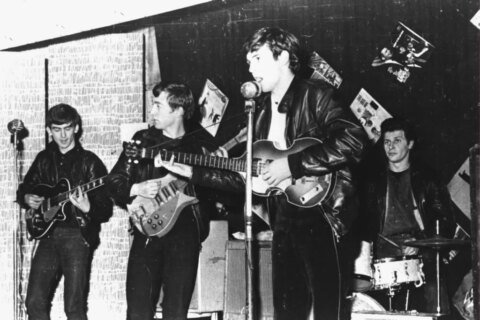


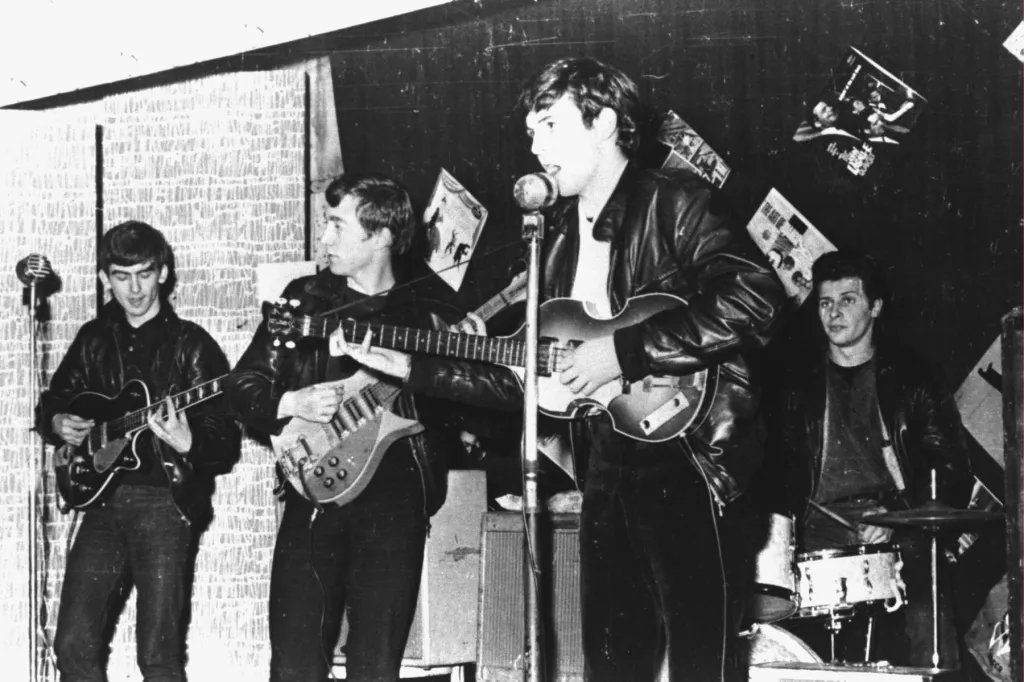

Geoff Emerick was just a teenager in June 1962, employed as an apprentice sound engineer at EMI Studios (later renamed Abbey Road), when a then-little-known English rock band recorded a demo in the studio.
John Lennon, Paul McCartney, George Harrison and drummer Pete Best laid down four tracks that day — “Bésame Mucho,” “Love Me Do,” “PS, I Love You,” and “Ask Me Why” — on a magnetic recording tape, which was then shuttled over to record producer George Martin at EMI’s headquarters on Manchester Square.
You know the rest: After ditching Best for Ringo Starr, The Beatles broke out with “Love Me Do,” launched Beatlemania, and became the most famous band of all time. Emerick rose with them, serving as chief engineer on iconic records like Abbey Road and becoming what Variety once called the “behind-the-scenes brains that helped shape the Beatles sound.”
But here’s what you probably don’t know: Emerick held onto that demo tape, which had been sent to a nearby squash court where “tapes went to die.” He kept it in his possession for decades, all the way until his 2018 death, when it was discovered among his things. And now, six decades after it was first recorded, Universal Music Group (UMG) wants it back.
In a legal battle quietly raging in Los Angeles court, both the music giant and Emerick’s estate are asking a judge to rule them the rightful owner of the tape, which UMG has called the “first known Beatles recording.” The estate’s lawyers say it was essentially thrown away, and that only Emerick saved it from destruction. UMG’s attorneys say it was always company property — and that it wasn’t his to save.
“At issue in this action,” the company’s lawyers wrote in recent court filings, “is a highly valuable artifact of rock and roll history that was stolen.”
——————–
Emerick was only 16 when he applied for a job at Abbey Road, apparently at the suggestion of a school guidance counselor. When he got the position, it came with a robust salary of about $8 a week: “Any disappointment I had in the low wages was more than offset by my elation at landing the position,” he recalled in his 2006 memoir. “At long last, I was in.”
For Beatles obsessives and audio junkies, the rest of Emerick’s career is well-known. He worked for several years under Norman Smith, the lead engineer on the Beatles’ early albums up until Rubber Soul. He then took over the top job in 1966 at Martin’s request, starting with the technologically innovative Revolver: “It was implanted when we started Revolver that every instrument should sound unlike itself,” Emerick once reportedly said.
For most of the band’s remaining years, Emerick was at the helm with Martin in the booth, perhaps most notably on the psychedelic, sound-effect-laden Sgt. Pepper’s Lonely Hearts Club Band, for which he later won a Grammy. The notable exceptions were the White Album, which he quit mid-recording session over the tortuous process of creating “Ob-La-Di, Ob-La-Da,” and the subsequent Let It Be. But he later returned for the band’s final session that yielded Abbey Road, then spent decades working with McCartney and other stars, including Elvis Costello and Supertramp.
“Geoff Emerick allowed the Beatles to break rules at Abbey Road, and to develop their penchant for new ways to record,” Bob Spitz, the author of The Beatles: The Biography, tells Billboard. “He also was the Beatles’ age. He was one of them as opposed to one of the suits, and that made him an important figure. He related to the band, and they trusted him.”
When Emerick passed away suddenly of a heart attack in 2018 at the age of 72, Martin’s son called him one of the “finest and most innovative engineers to have graced a recording studio.” McCartney himself eulogized him as someone who had been “always open to the many new ideas that we threw at him” during the later Beatles albums: “I’ll always remember him with great fondness, and I know his work will be long remembered by connoisseurs of sound.”
Because he died without a will, spouse or children, Emerick’s case was sent to probate court — a legal process designed to sort out the affairs of people without clear estate planning (the same thing that befell Prince‘s estate after his 2016 death). A Los Angeles judge eventually named a group of Emerick’s cousins as his heirs and appointed an administrator, Maya Rubin, to figure out what they’d inherit.
While searching through his Laurel Canyon house, Rubin and others came upon that 1962 demo. “The master tape is significant as an artifact of early Beatles recordings,” she wrote in a 2019 court filing. “[It] was recorded in June 1962 and features the Beatles’ original drummer, Peter Best, rather than Ringo Starr.”
UUMG, which had acquired EMI in 2012, quickly found out about it. In their own court filings, the label’s lawyers said the company had been alerted to the tape’s existence when it was listed online for sale to “the highest bidder” just weeks after Emerick’s death. The company said it had reached out and “demanded its return,” apparently unsuccessfully.
The tape was no small find. While it’s hard to exactly confirm the claim that it’s the first known Beatles recording — earlier recordings exist of McCartney-Lennon-Harrison as The Quarrymen, as do copies of the famed Decca audition — it’s certainly a cultural talisman of the highest order. The June 6 session was their first at Abbey Road and plays a key part in the historiography of the period just before the Beatles became world-famous.
“When you have a band that’s as big as The Beatles, every little snippet that they made is historic and something to be treasured,” says Spitz.
With ownership of that object disputed, both sides filed formal petitions in probate court, asking the judge to confirm them as the owner. And so the battle was on.
——————-
It seems Emerick wasn’t actually present at the now-fateful June 1962 session. In his memoir, he recounts his first run-in with the Beatles as taking place at a later 1962 recording session that featured Starr, not Best, on the drums. The estate says in court filings that Emerick was “not at the test recording session”; UMG says he was “employed at EMI during the recording.”
But both sides agree that he was there two years later, in 1964, when fellow EMI engineer Ken Scott alerted him about the existence of the Beatles demo tape. Scott noticed that the tape had been left in a nearby squash court — a spot located across the street from Abbey Road that EMI had started using in the mid-1950s to store old tapes. So Emerick went to the squash court, found the tape, and took it.
That’s where the agreement stops. In its legal filings, Emerick’s estate argues the court was essentially a garbage dump — a place where “tapes went to die” — and that by sending it there, EMI had legally abandoned ownership of it. The estate says Scott had been specifically sent there to “dispose of such discarded tapes in the rubbish,” but that he instead “put them aside and told Emerick.”
The estate says Emerick aimed only to “rescue” the tape from destruction, and that it “would not exist today” if not for him: “[UMG] intentionally abandoned ownership of the master tape and box by sending them across the street to the squash court to be discarded with similarly abandoned property.”
UMG sees things differently. It says the squash court was still company-controlled property, and that a tape sent there was not abandoned but merely “no longer a work in progress.” Ken Townsend, another legendary Abbey Road engineer, gave a sworn statement that it had been strictly against the rules to remove tapes from the court: “If you were employed by a company, you didn’t steal their goods,” he said.
UMG’s lawyers argue the old tapes were not free for the taking, regardless of whether they were marked for destruction. “It is obvious that when a recording artist or studio discards an unwanted recording, he or she does not actually mean to ‘abandon’ it to the public domain,” they write. “A novelist who throws away pages from a handwritten first draft of a story cannot possibly intend that a trash-picker can acquire ownership of the draft and publish it himself.”
The case gets more complicated from there. The estate also argues UMG’s claim to the tape is barred by the statute of limitations, which it says lapsed six years after the tape left the studio. UMG says that’s not true — that Emerick fraudulently took the demo and then lied about it, including when directly asked about it as EMI was assembling materials for the 1990s Beatles Anthology albums.
The final disputed issue involves paperwork. The estate argues UMG cannot show a “chain of title” that proves it is even the rightful legal successor to Abbey Road, and thus lacks standing to demand the return of the tape in the first place. UMG, meanwhile, says that issue was settled long ago and is obviously incorrect.
After a key court hearing earlier this month, the two sides are now finally headed for a showdown. First, they’ll submit briefs to the judge on key issues in the case, then head to trial early next year if the dispute is still not resolved.
In a statement to Billboard, the estate’s lead attorney, Kenneth D. Freundlich, says Emerick preserved an artifact that had been “destined for destruction” and had never hidden it from anyone over the subsequent decades. He says UMG is now, years later, unfairly asking a court to “brand one of the most respected recording engineers in music history a thief.”
“The corporation that was throwing this tape in the garbage in 1964 does not get to rewrite history 60 years later,” Freundlich says. “Geoff Emerick saved this piece of music history, and Ms. Rubin’s obligation is to gather and protect the property of Mr. Emerick’s estate, and she will vigorously resist any effort to besmirch his reputation or diminish his legacy.”
A spokesman for UMG declined to comment on the dispute.
——————–
The unspoken question hanging over the case is what each side intends to do with the tape. Does the estate plan to sell it off and split the money among Emerick’s heirs? Does UMG plan to release these decades-old recordings to a fandom eager for any unheard Beatles material?
On that one, the answer doesn’t actually seem to depend on the outcome of the case. In court filings, the estate explicitly acknowledges that it has no rights to the music itself and that UMG owns the copyrights to the songs. Freundlich says the estate has already handed over digital copies to UMG, meaning the label could theoretically release the songs without recovering the physical tape.
Neither side would comment on their plans if they win the case. But one thing is clear: That tape is worth a lot of money.
Back in 2015, The Beatles’ first-ever contract with manager Brian Epstein was sold at auction for more than $550,000. A few years prior, a handwritten sheet of lyrics to “A Day in the Life” sold for $1.2 million at Sotheby’s. The band’s instruments have repeatedly sold for far more than that.
The most direct comps are perhaps a bit lower. In 2016, a 10-inch acetate record from 1962, the first known Beatles disc to be cut, sold at auction for $110,000. But Elvis Presley’s first recording, a 1953 acetate, went for $300,000 in 2015.
For Beatles experts like Spitz, regardless of the actual price, such a find is “invaluable” from a historical perspective. “It’s like finding another original copy of the Constitution,” he says with a laugh. “It’s like the Shroud of Turin.”
“It’s a part of Beatles history,” Spitz continues. “And that Beatles history is one of the most valuable parts of rock and roll history.”